
The First Bad Match Is Not Failure: What the J-Curve Teaches Us About AI Adoption
As the World Cup approaches, football — or soccer, depending on where you live — gives us a useful way to think about enterprise AI adoption.
When a football team changes its system of play, the first matches can look uncomfortable.
Players hesitate.
Passing lanes are not automatic yet.
The press arrives late.
The defensive line loses shape.
The midfield does not know whether to hold, cover, or attack.
The team may look slower before it becomes faster.
A superficial observer might say:
The new system is not working.
But a good coach knows something deeper:
The team is learning.
The early instability may not be evidence of failure. It may be the cost of changing the way the team plays.
Enterprise AI adoption follows a similar pattern.
Many organizations expect artificial intelligence to deliver immediate productivity gains. They buy licenses, deploy copilots, test agents, encourage employees to experiment, and wait for performance to improve.
Sometimes it does.
But often, the first phase feels messier than expected.
Teams spend time learning new tools.
They rewrite workflows.
They verify outputs.
They debate what can be delegated.
They discover gaps in documentation.
They expose weaknesses in testing, security, architecture, data, and governance.
This does not automatically mean AI is failing.
It may mean the organization has entered the J-Curve of AI adoption.
What is DORA, and why does it matter?
DORA is Google Cloud’s research program focused on software delivery performance, organizational capabilities, and the practices that help technology teams deliver software safely, quickly, and reliably.
Its work matters because it connects engineering practices with business outcomes. Instead of treating software delivery as a purely technical activity, DORA helps leaders understand how throughput, instability, rework, developer experience, user value, and business impact are connected.
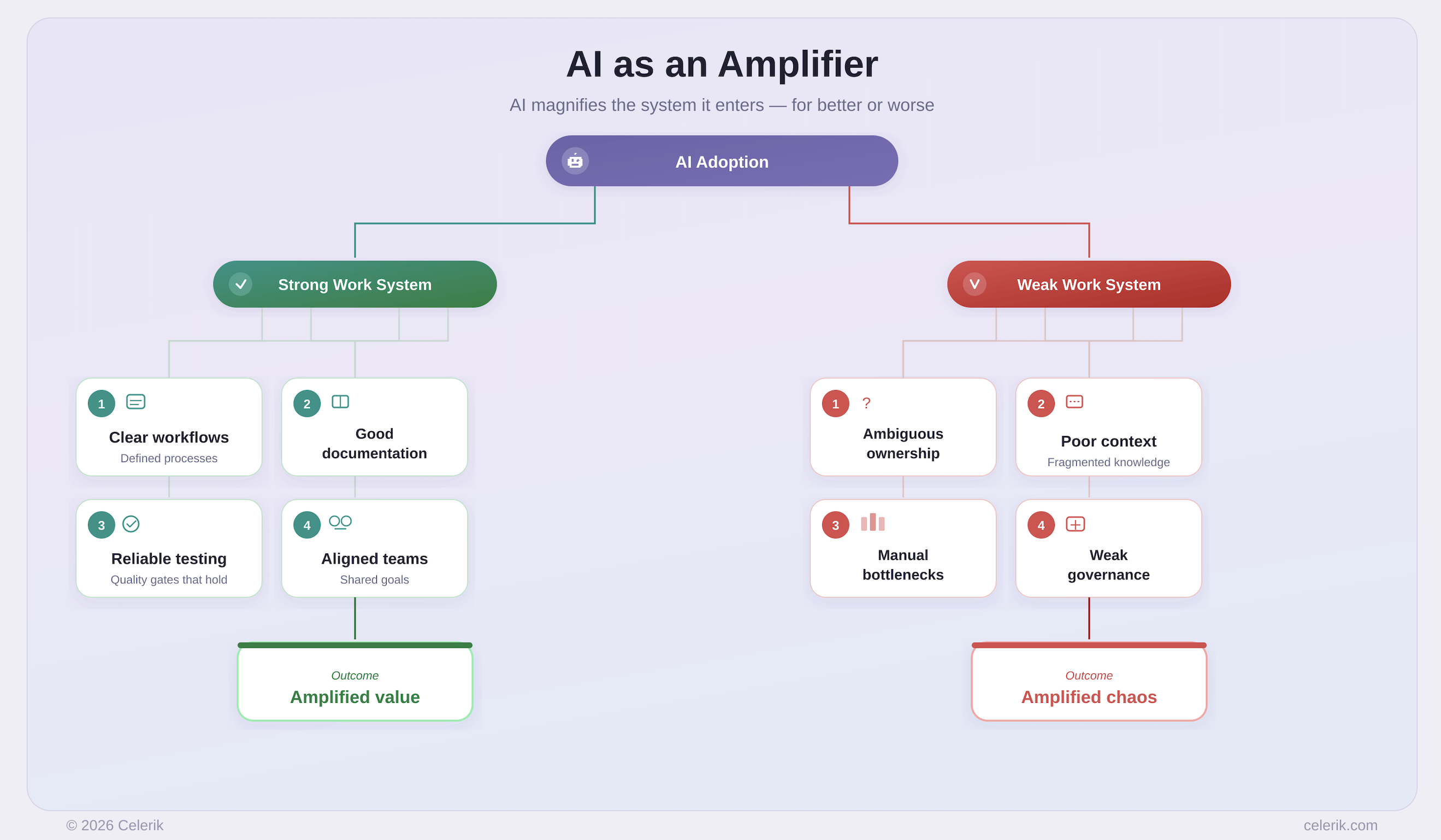
In its report on the ROI of AI-assisted software development, DORA argues that AI is not simply a productivity tool. AI acts as an amplifier. It can magnify the strengths of high-performing organizations, and it can also magnify the dysfunctions of struggling ones. The report warns that the greatest returns do not come from tools alone, but from the underlying organizational system: internal platforms, workflow clarity, and team alignment.
That point is critical.
AI does not enter a vacuum.
It enters real teams, real workflows, real incentives, real bottlenecks, real documentation, real architecture, real governance, and real leadership decisions.
If the system is strong, AI can amplify strength.
If the system is fragile, AI can amplify fragility.
What is the J-Curve of AI adoption?
The J-Curve describes a pattern common in major transformations.
Performance may temporarily decline before it improves.
In AI adoption, this dip can happen because teams are not only adding a tool. They are learning a new way of working.
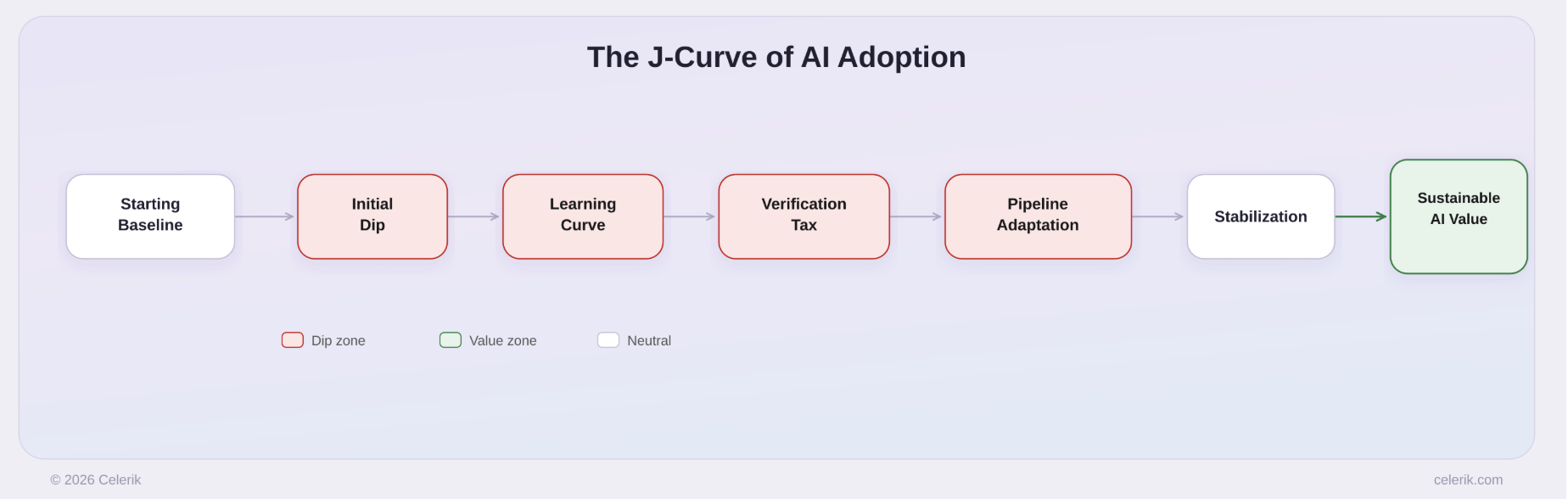
DORA describes this early dip as a combination of three forces: the learning curve, the verification tax, and pipeline adaptation. The report frames the dip as a temporary productivity decline and period of instability associated with early adoption — a tuition cost of transformation rather than an automatic signal of failure.
The three forces matter.
The learning curve appears because people need time to learn the tools, understand their limits, and develop new habits. Early AI use often starts with simple prompting, but mature use requires better context, clearer intent, and stronger specifications.
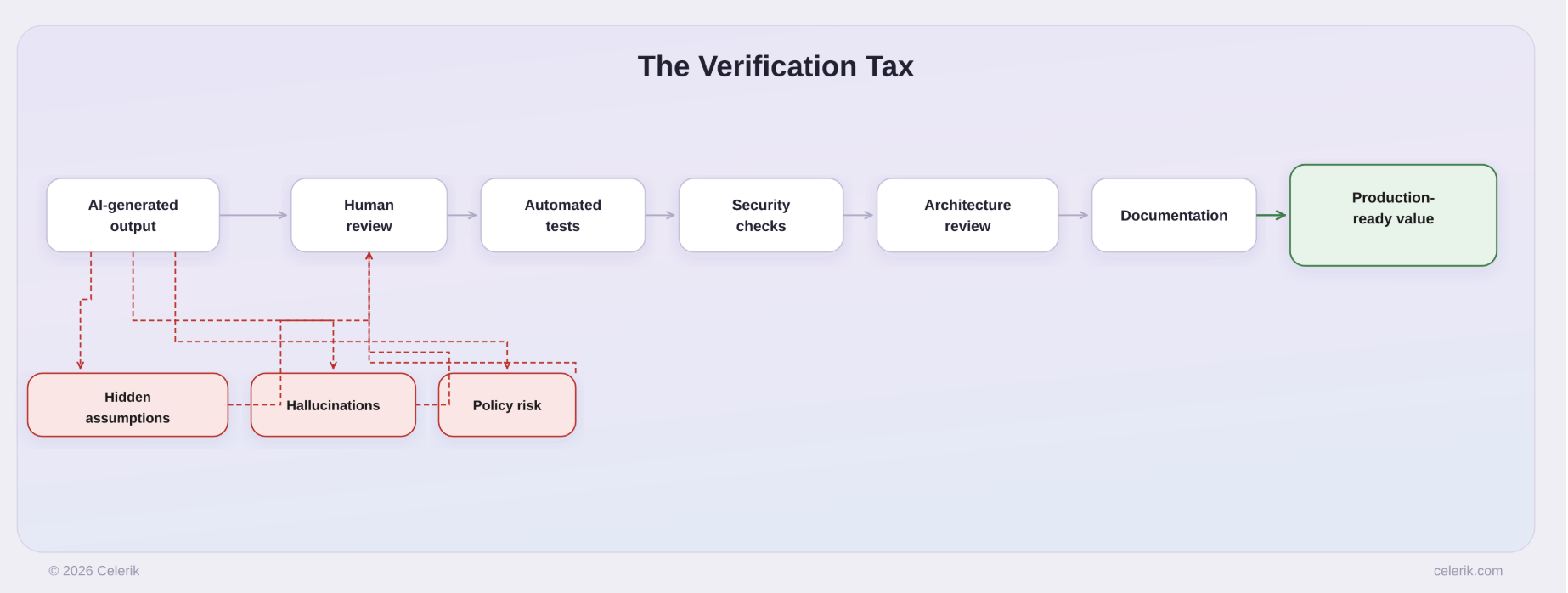
The verification tax appears because AI-generated output still needs to be reviewed. Code, documents, analyses, decisions, and automation steps may look correct while hiding assumptions, errors, or risks.
Pipeline adaptation appears because faster individual output creates pressure downstream. Testing, review, approvals, security, deployment, documentation, and governance all need to adapt.
In football terms, this is what happens when a team changes formation.
The problem is not only that players need to learn new positions.
The whole system must adapt.
The midfield has to know when to press.
The fullbacks need to know when to overlap.
The center backs need to know when to hold the line.
The goalkeeper needs to understand the new passing options.
The substitutes need to know how the system changes late in the match.
A new system is not learned by announcement.
It is learned through practice, feedback, correction, and repetition.
AI adoption works the same way.
The first dip is a leadership test
The J-Curve is not just a technical concept.
It is a leadership test.
When leaders do not expect the dip, they often react in one of two ways.
They either pull back too early, assuming AI is not working.
Or they keep pushing for speed, even when quality, trust, and stability are declining.
Both reactions are dangerous.
Pulling back too early prevents the organization from reaching the value phase.
Pushing speed without redesigning the system creates downstream chaos.
The better response is to manage the dip deliberately.
That means planning for it, budgeting for it, measuring it, and designing the work system that helps the organization move through it.
In football, a coach changing the system does not simply tell players to run faster.
The coach studies where the team loses shape.
Are the roles unclear?
Is the midfield too disconnected?
Are defenders receiving the ball under too much pressure?
Is the team pressing without coordination?
Are players uncertain about when to attack and when to reset?
Enterprise AI requires the same type of diagnosis.
Are people clear on what AI can do and what humans still own?
Is internal documentation usable by AI tools?
Are outputs reviewed with the right criteria?
Are tests and guardrails strong enough?
Are teams measuring business value or just activity?
Are workflows being redesigned, or are AI tools being inserted into broken processes?
The J-Curve exposes the quality of the system.
The verification tax is real
One of the most important concepts in AI adoption is the verification tax.
The verification tax is the extra effort required to review, test, validate, correct, document, and govern AI-generated work.
It appears when developers need to review generated code.
It appears when analysts need to check AI-generated summaries.
It appears when product teams need to verify assumptions.
It appears when customer-facing logic needs quality control.
It appears when legal, financial, or operational decisions require human accountability.
The verification tax is not a reason to avoid AI.
It is a reason to design better workflows.
DORA reports that increased AI adoption has been associated with positive effects such as individual effectiveness, code quality, software delivery throughput, and team performance. But it also notes an increase in software delivery instability, because AI-assisted coding can increase the volume and velocity of generated code, overwhelming existing pipelines and manual review gates.
This is the paradox leaders must understand:
AI can increase speed and instability at the same time.
That is why the goal is not simply more AI-generated output.
The goal is more reliable value.
In football, speed without shape is dangerous.
A team can attack faster and still concede more goals.
The same is true in software.
A team can generate more code and still create more rework, more defects, and more operational risk.
Why ROI cannot be measured by license adoption alone
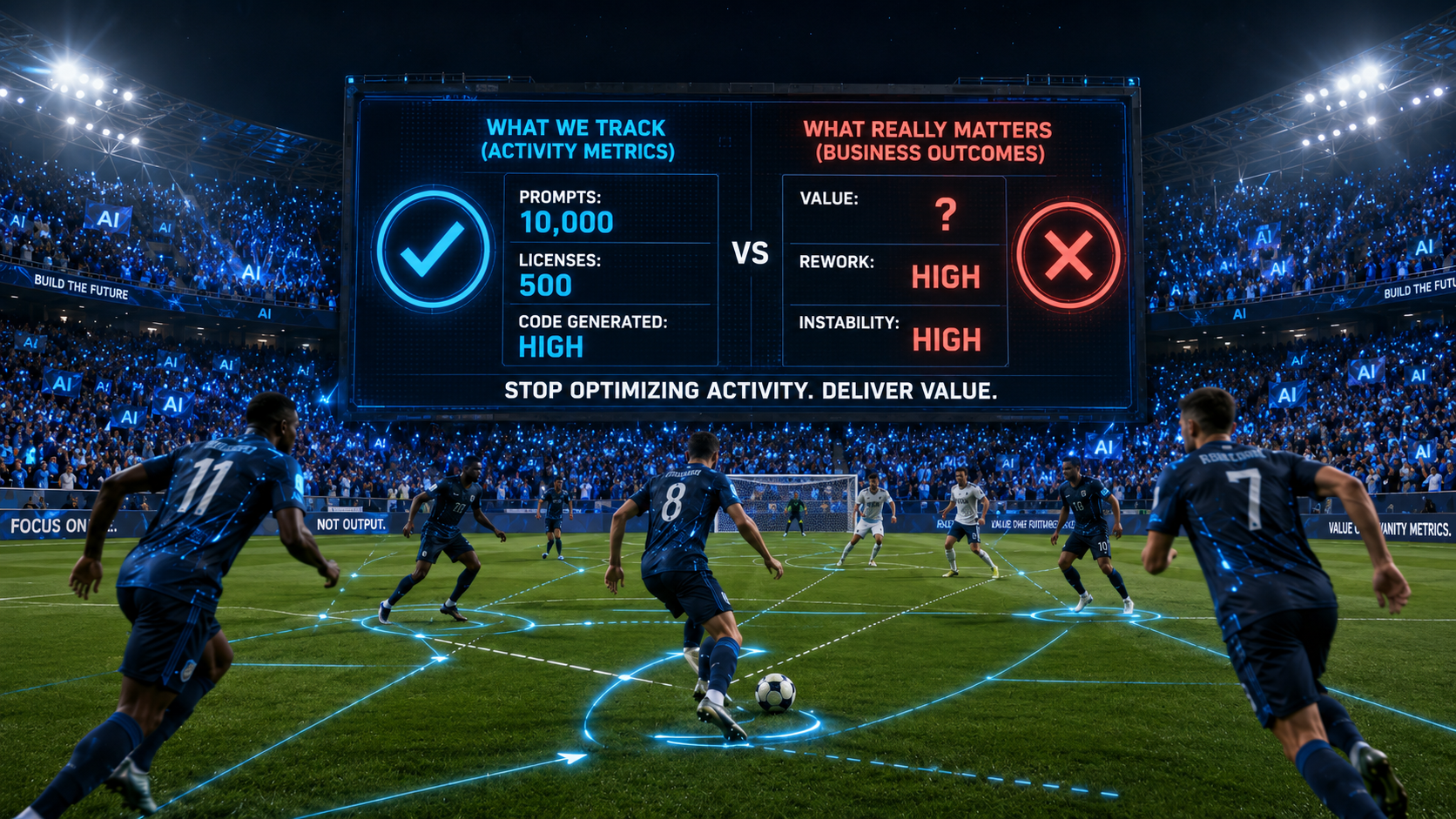
Many companies still measure AI adoption using activity metrics.
How many licenses were activated?
How many people used the tool?
How many prompts were submitted?
How many agents were deployed?
How much code was generated?
Those numbers may be useful, but they do not prove business value.
The real question is not whether people are using AI.
The real question is whether AI is improving the performance of the whole system.
DORA’s ROI report emphasizes that measuring software delivery performance is essential to forecasting the ROI of AI because it connects engineering metrics with financial impact. It highlights throughput and instability as two key dimensions: throughput reflects the volume and velocity of changes moving through the engineering system, while instability reflects the reliability and success rate of deployments.
That means leaders need a better scoreboard.
A useful AI scoreboard should include:
- Throughput: Are teams delivering valuable work faster?
- Instability: Are failures, defects, incidents, or rework increasing?
- Rework: Are people spending less time correcting avoidable mistakes?
- Quality: Is AI improving the reliability of the output?
- User value: Are customers or internal users experiencing better outcomes?
- Human capacity: Are people freed for higher-value work, or just pushed to produce more?
- Business impact: Are AI-enabled improvements connected to revenue, savings, risk reduction, or strategic outcomes?
In football, possession does not guarantee victory.
Shots do not guarantee goals.
Passing speed does not guarantee control.
The scoreboard matters because it tells the team whether the system of play is actually working.
Enterprise AI needs the same discipline.
The goal is not headcount reduction
A common mistake in AI ROI conversations is reducing the entire discussion to labor replacement.
That framing is too narrow.
It can also damage trust.
DORA recommends that productivity gains be framed as freeing capacity for innovation and value creation, rather than as a headcount-reduction strategy. The report argues that reducing unnecessary rework can recover engineering capacity that can be reinvested into building new features and driving innovation.
This is an important leadership principle.
AI should help organizations reduce toil, improve flow, remove bottlenecks, and create room for higher-value work.
The question should not be:
How many people can we replace?
The better question is:
What new value can our people create when AI removes systemic friction?
In football terms, the goal is not to remove players from the field.
The goal is to help the team play better.
How leaders can move through the J-Curve
Moving through the J-Curve requires more than patience.
It requires intentional design.
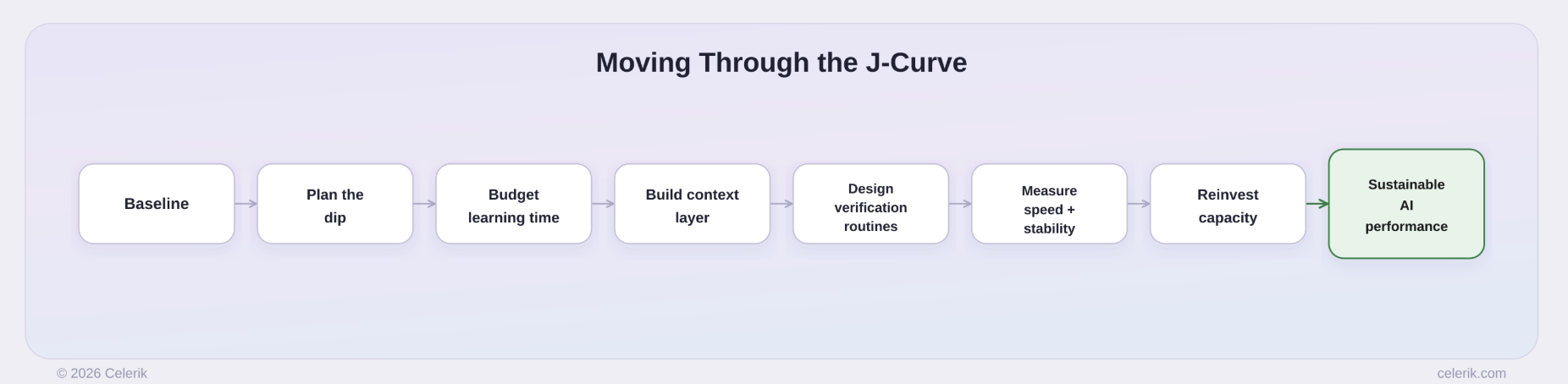
Leaders should start by establishing a baseline. Before claiming AI has improved performance, teams need to understand how work performs today. What is the current throughput? Where does rework happen? How long do reviews take? Where do handoffs slow down? What kinds of failures are most common?
They should also budget for the learning phase. AI adoption has visible costs, such as licenses and infrastructure, but it also has hidden costs: enablement, workflow disruption, verification time, process redesign, and governance.
They should strengthen the context layer. AI becomes more useful when it can access clear internal standards, documentation, APIs, architecture decisions, product knowledge, user needs, and business rules.
They should design verification routines. Human review should not be vague. Teams need clear criteria, risk thresholds, test coverage, escalation paths, and documentation practices.
They should protect learning. People need time to experiment, compare approaches, share patterns, and build judgment. AI capability is not developed through tool access alone.
They should measure both speed and stability. Faster delivery with higher instability is not sustainable value.
The best AI strategies improve flow without increasing chaos.
From AI adoption to Human-AI Work Design
This is where Human-AI Work Design becomes essential.
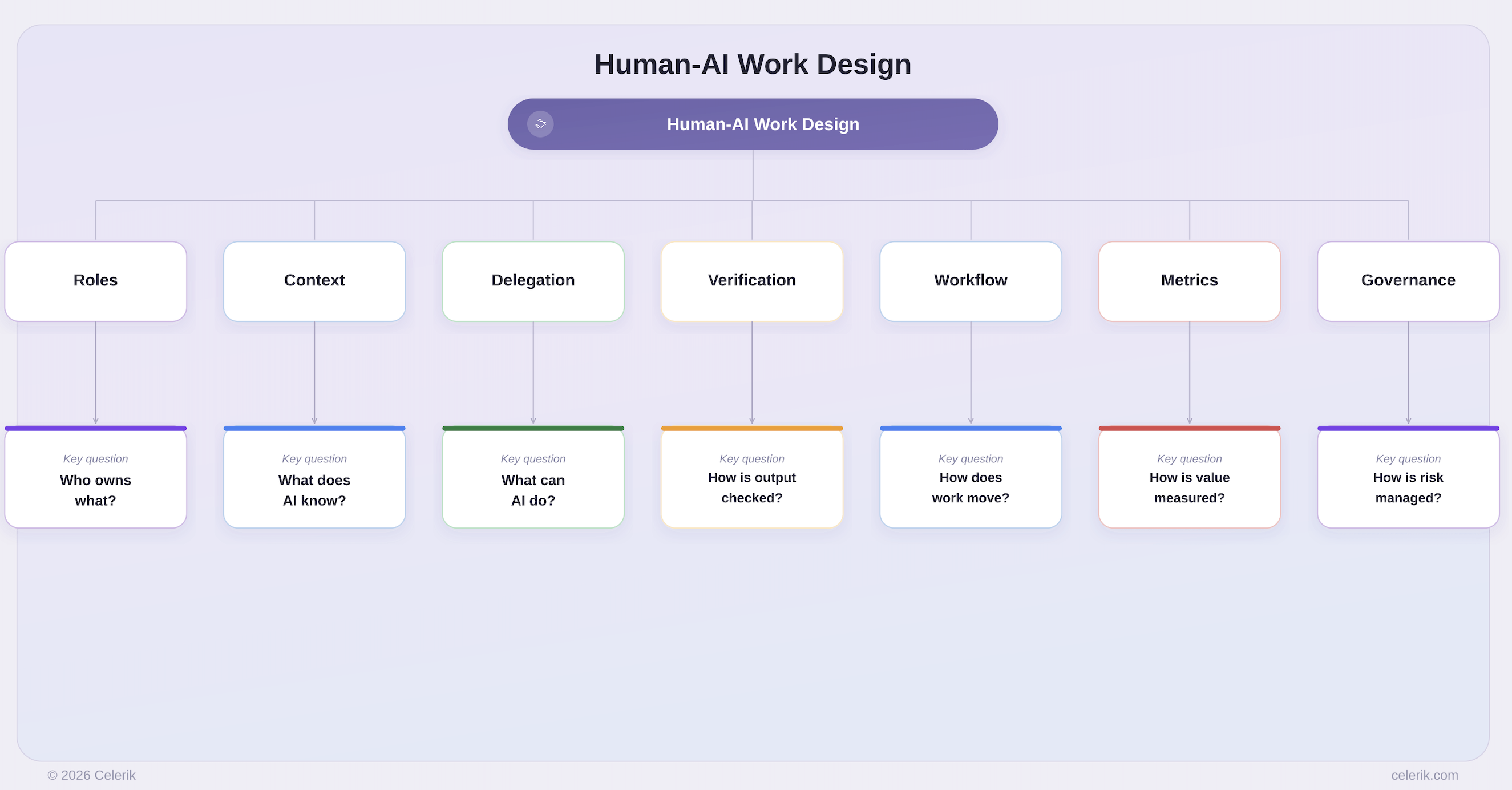
Human-AI Work Design is the discipline of redesigning how people learn, delegate, verify, collaborate, and are evaluated when AI becomes part of everyday work.
It is not just prompt engineering.
It is not just AI literacy.
It is not just tool training.
It is the design of the human-AI operating system inside the organization.
In software teams, this includes how people define requirements, create specifications, delegate tasks to AI, verify outputs, document decisions, manage uncertainty, and measure impact.
In enterprise functions beyond software, the same discipline appears through rubrics, policies, review checkpoints, escalation rules, workflow cards, role-based capability models, and governance routines.
The principle is the same:
AI creates value when the work is redesigned around it.
This is why the J-Curve matters.
It reminds leaders that early friction is not automatically failure.
But it also warns them that value will not appear by magic.
A team does not become better just because it changes formation.
It becomes better when the formation is trained, understood, measured, corrected, and adapted.
Enterprise AI needs the same level of discipline.
The leadership question
The first bad match is not always failure.
Sometimes it is the beginning of a better system.
But only if leaders understand what they are seeing.
The J-Curve tells us that early AI adoption may bring friction before value. DORA’s research helps explain why: AI amplifies the system it enters, and the path to ROI depends on organizational foundations, not tools alone.
So the leadership question is not only:
Are we adopting AI?
The better question is:
Are we designing the system that allows AI adoption to become sustainable value?
At Celerik, we help organizations move from AI tool adoption to Human-AI Work Design: redesigning workflows, roles, verification checkpoints, capability-building systems, and value metrics so AI can create measurable and sustainable business impact.
Do not abandon the system after the first bad match.
Study the dip.
Design the work.
Build the capability.
Measure the value.
That is how organizations move through the J-Curve.
And that is how AI adoption becomes AI performance.

Explore the full Human-AI Playbook series:
View the master index and upcoming publications →